


Esports in 2026 – The Explosive Growth, Billion-Dollar Revenues & Betting Boom You Can’t Ignore


Esports entered 2026 looking like a mature global entertainment business that has come a long way. No one can deny that the industry has experienced tremendous growth in the last couple of years. Aside from the countless new tournaments and events worldwide, even institutions like the International Olympic Committee have taken an interesting approach to the sector since 2018, which shows how seriously it is being treated.
Considering all of that, Nostrabet’s team and I found that there’s a forecast for the games market, suggesting it could reach $213.3B by 2027. The fact that this sector keeps growing means that esports will continue to develop alongside it.
Today, the sector is much more developed in some parts of the world, and I am about to share more information about that. We will take a look at the leading countries in 2026, the events and games that set the trends, and much more.
A Market Built on Audience Scale
The first big reason why esports is growing in 2026 is because of people and the fact that they love watching it. If you have some experience, you know that the biggest tournaments in the world attract millions. In 2024, for example, the VALORANT Championship Grand Final reached 9.13M peak viewers and around 44.38M unique viewers. Millions also watch tournaments like The International (Dota 2) and the League of Legends World Championship (LoL).
Since people expect the global game industry to include more than 4 billion people, the potential for esports is huge. Sure, not everyone who plays games will become an esports fan, but some will. This is one of the big reasons why esports remains such an attractive long-term ecosystem for companies. The potential is on another level.
Esports Market Revenue – The U.S. Is Leading The Way
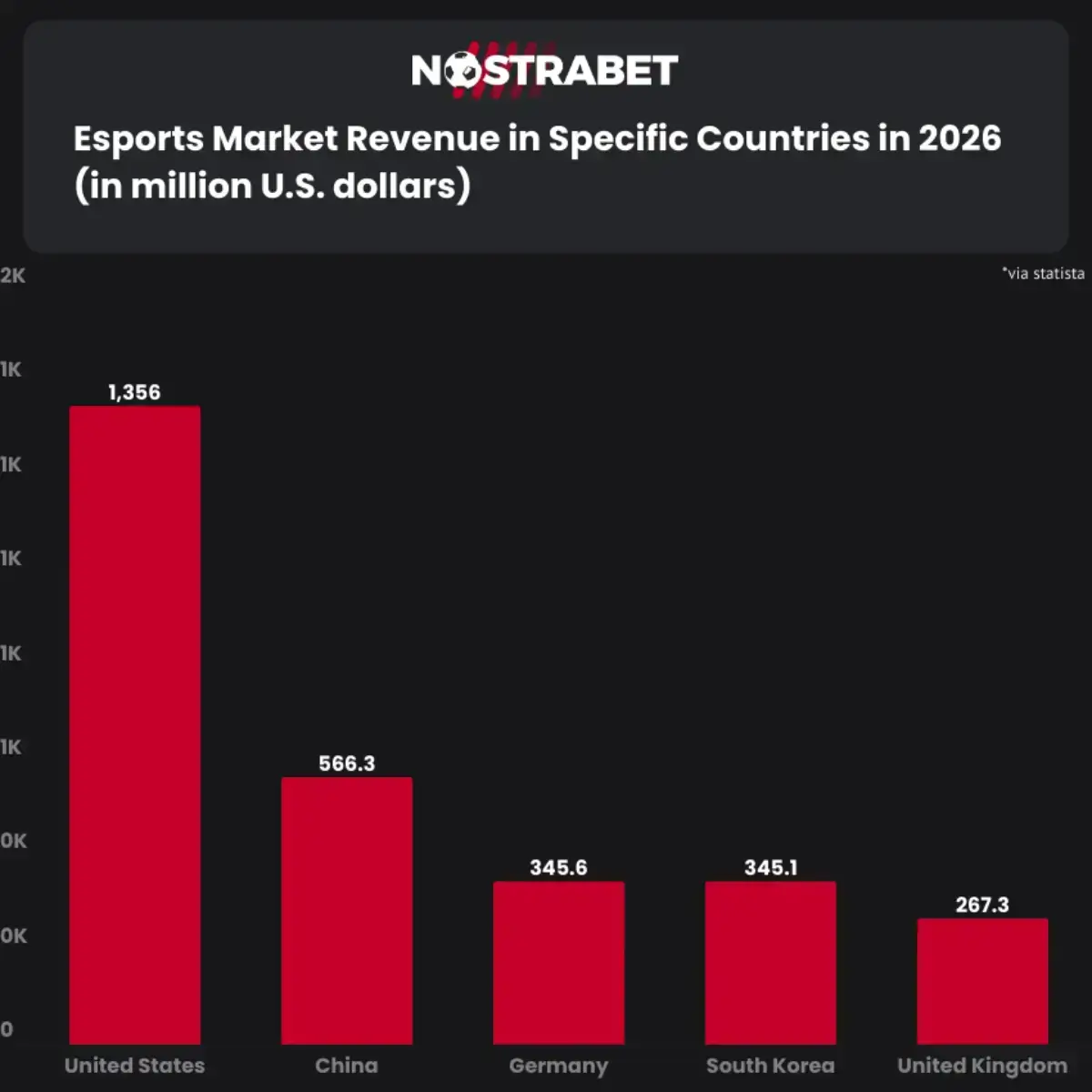
I found an interesting statistic that showcases the esports market in some countries. It’s probably not a surprise that the U.S. comes out on top and has a significant lead over the second place on the list. The esports market there reached $1.35B in 2026.
The reason why the U.S. tends ot dominate is because of three main things:
- Premium sponsorship
- Pro-advertising approach
- High-value media partnership
American esports benefits from deep capital markets and a huge consumer economy. Moreover, many of the world’s biggest esports tournaments were held there alone until a few years ago. This does not mean that the USA has the most passionate esports fans in the world, but it shows how finances can make a huge difference.
Moving on to the second country on the list, it’s no surprise that we have China. Generally speaking, Asia plays a crucial role in the industry because it’s a hub for emerging teams and passionate fans. China is currently the leading nation in terms of revenue, with $566.3M in 2026.
The third-largest esports market by revenue is Germany, with $345.6M. Again, esports fans are probably not surprised, since Germany has long been esports’ stronghold in Europe. Many of the best players in the world across different titles come from this country.
South Korea is next with $345.1M and is probably the most surprising name on the list. South Korea is the leading country in games like League of Legends and is home to Faker and many other world-class players. Considering how things are changing there, I am almost certain it will surpass Germany really soon.
The United Kingdom
The last country on the list in terms of market worth (in 2026) is the UK, with around $267.3M. Despite being in 5th place, it is one of Europe’s curricula markets because of its strong infrastructure and growing audiences. It may not be on the same level as the U.S. and China yet, but this could change.
The stats project that the revenue will surpass $300M by 2030, and this will make the UK among the fastest-growing esports markets in Europe. Diving deeper into the stats shows that more than 4M people in the country have watched esports. Some stats reveal that 54% of UK gamers say esports has become more popular recently.
What also makes the UK such an important esports market is the betting culture. The country has one of the largest sports betting markets in the world, and many people bet on esports.
Prize Pools, Prestige and Spectacle Economy
The next big reason why there’s a big growth in esports in 2026 is related to the tournaments’prize pools. Fans probably remember that the 2025 Esports World Cup had a total reward of more than $70M. This surpassed last year’s $62.5M and set a new benchmark for esports prize money.
The fact that players compete for such jaw-dropping amounts creates headlines and attracts casual attention. It also reinforces legitimacy and gives fans a clear signal that the industry is operating on a global stage.
Having said that, a giant prize pool does not mean that every team, league, or event is financially healthy. In fact, only a handful of the big esports teams are doing well financially. Many struggle to be profitable because of overspending, and they will have to step up their game in 2026.
Despite all that, the big prize pools definitely add prestige to the industry as a whole. The general audience may not be familiar with the different leagues and players, but they understand that a $70M prize pool means business. This clearly shows that esports is no longer just a hobby.
The Esports Betting Boom – Opportunity, Engagement and Risk
If there’s one clear example of the esports industry’s growth, it is related ot the betting sector. Anyone who’s been betting on sports for a few years remembers how bookmakers used to offer just a few games and options. Today, almost all big names in the industry have dedicated esports betting sections. This means the industry is growing rapidly among sports bettors worldwide.
A quick look at some statistics reveals that the global esports betting market is currently valued at around $14.17B in 2026. The numbers reveal that the segment is expanding drastically and will continue to attract new bettors.
But why is that happening? Well, I personally believe that esports offers a lot more than regular sports when it comes to betting. You have constant match volume, deeply engaged digital-native audiences and communities that are passionate. Aside from that, live streaming plays a huge role because bettors love watching the matches they bet on. Unlike regular sports, almost all esports events you can bet on will come with a dedicated live stream.
The growth of esports betting also comes at a cost, and it is related to responsible gambling. Many commissions across the world have raised awareness and require bookies to take action. Since esports has a younger fan base, companies must do everything in their power to ensure people’s safety.
Another concern related to esports betting is often not discussed, but it exists: match-fixing. Even though this is not an issue among Tier 1 events, it happens a lot when punting on smaller competitions. Suspicious betting patterns occur daily, and it’s something you need to be aware of.
The Games That Keep the Engine Running
I have to point out that the esports growth in 2026 depends heavily on something that people overlook – the games themselves. Not every competitive title can sustain a global ecosystem, and some are much more important than others.
Although there are some new additions, most people like the following options:
- League of Legends
- Dota 2
- Counter-Strike 2
- VALORANT
These 4 remain the centre of attention because they have established competitive brackets. Each game comes with a variety of tournaments held all over the world and attracts millions of viewers annually. People return to see the rivalries and follow every roster move.
I also have to mention a few words about the big mobile titles, such as Mobile Legends: Bang Bang. Even though they are much more popular in Asia than elsewhere, they are still growing rapidly. In fact, some stats show that, as of April 2026, the game is leading in viewership, with peak viewership reaching 5.6 million.
What Comes Next After 2026
If we try to predict what could happen with esports in 2026, we believe the growth will continue. However, most experts believe there will be steady growth, which means the industry has matured in the last couple of years.
Going back to the Olympic angle I mentioned earlier, this is one of the best signs for the industry as a whole. It shows that esports is just too large to ignore and finally gets the attention it has always deserved.
Another key trend to follow is the increasing involvement of traditional sports organisations and media giants. We have several big sports clubs that invest in esports teams and tournaments. I personally really like this crossover because it will likely bring new audiences and further legitimise competitive gaming in the eyes of mainstream viewers.
I also expect to use improvements in streaming quality, VR, and augmented reality. Having the option to watch live matches and even interact with players in real-time might be a lot closer than most people think.
Conclusion
I can safely say that esports in 2026 is no longer a niche industry. It has transformed into a global entertainment powerhouse driven by massive audiences, billion-dollar revenues and constant innovations. Countries like the USA and China continue to send the trends, but emerging markets like the UK are catching up fast.
What stands out most in the industry is its ability to adapt. New tech, growing mainstream recognition, or deeper integration with traditional sports allow esports to expand its reach. Despite the growing challenges around the world, everything indicates that esports is here to stay.
No comments added yet. Be the first!