


Dota 2 Ranks & MMR Explained: Complete Guide


Many Dota 2 players will agree that MMR is just a number. This may be true in some cases, but the Dota 2 ranks matter far more than many people would like to admit. They reflect the amount of hours you put into playing and show others your current skill level.
But how do the Dota 2 ranks and MMR systems actually work? I have been playing the game long enough to know the algorithm inside out, so this article will answer all of your questions. Other Nostrabet.com members and I have been fortunate to reach the highest Dota 2 rank (Immortal), and I’d like to provide my practical insight into how everything works.
Dota 2 Ranks Explained
People asking “What are Dota 2 Ranks” will discover that these are “medals” that represent a given player’s skill in ranked games. The idea of these ranks is to place players with similar skill levels in the same bracket. As a result, players should have a balanced experience.
Every ranked match that you win in Dota 2 will help you increase your rank. Losing, on the other hand, will decrease it. As mentioned, the Dota 2 ranks are shown as medals on your profile, and everyone can see them.
Currently, Dota 2 has 8 different ranks as follows:
- Herald
- Guardian
- Crusader
- Archon
- Legend
- Ancient
- Divine
- Immortal
Each of these ranks has five subranks (or stars), except for Immortal. The only way to progress from one rank to another is to “unlock” all of the stars in that particular level. People who reach Ancient V will be able to unlock Immortal I, for example.
Usually, you will need around 154 MMR to get from one star to another in a particular level, at least until you reach Divine. Once that happens, it becomes slightly harder, so reaching Immortal will take some time (unless you are on an excellent win streak).
Dota 2 MMR
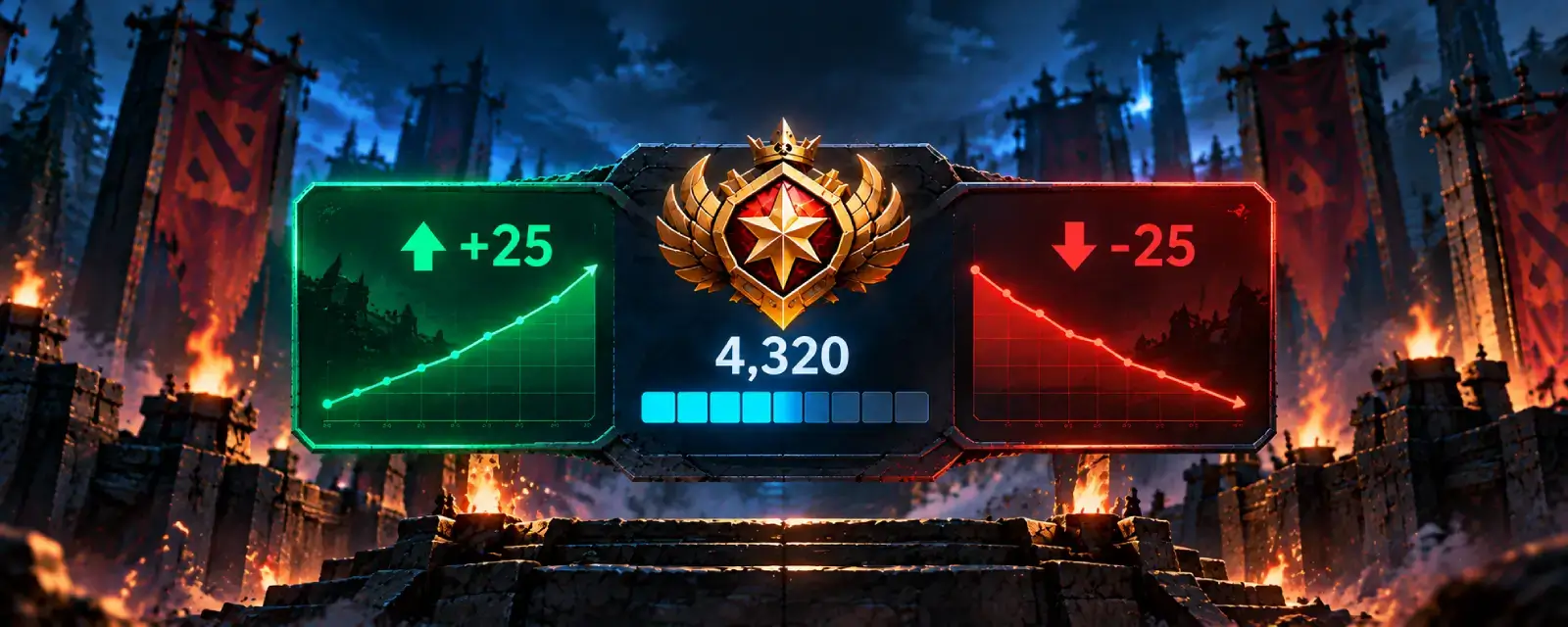
MMR stands for matchmaking rating, and it’s a numerical value that you have on your profile. In fact, the ranks themselves are determined based on the player’s MMR. It increases with each win and decreases with each loss. Reaching a specific MMR allows you to “unlock” that particular Dota 2 rank.
Every ranked match you have in Dota 2 has some kind of effect on the MMR. Winning allows you to increase it, whereas losing will decrease it. There are, however, several twists that you need to be aware of, and I want to focus on them.
Generally speaking, winning a Dota 2 game will result in +25 MMR, whereas losing means -25 MMR. This is only accurate if the Glicko system and Rank Confidence are working properly. More about those in a bit.
It’s important to know that your stats in the game do not matter when it comes to gaining or losing MMR. You can end a Dota 2 match with the score of 0/10 and win, and you will still receive the same MMR as someone who is 20/0.
What are Rank Confidence and Glicko
As mentioned earlier, the Dota 2 MMR you gain or lose per game will depend heavily on these two components.
The Glicko system is essentially Dota 2’s method for determining a player’s skill level when Rank Confidence is low. Rank Confidence is a special percentage that shows if the Dota 2 system is confident that the MMR reflects your current skill level.
People who have not played in a while will have very low Rank Confidence, which means that the MMR they gain or lose will be all over the place. I have been in situations like that, and I had two matches with around a 1500 MMR difference between the players I met/played with.
Once the Rank Confidence reaches at least 30%, you will be calibrated. Dropping below that means you will need to recalibrate again and will have to play several games before the system gathers enough information about you.
Dota 2 Ranking Player Distribution
My research and experience show that the vast majority of Dota 2 players fall within the Crusader and Archon range. In fact, I’d say that around 50% of all players are between these skill brackets. People who play there are familiar with all core mechanics and know how the game works.
As for the high ranks in Dota 2, they represent a very small percentage of ranked players. For example, some sources state that Divine V players, for example, represent just 0.9% of the total player base.
Another personal observation is that the Crusader and Legend brackets are where you will find most smurfs. People interested in smurfing will have another account, and once they’re done ranking it, they are usually placed within one of the two brackets. So, next time you see someone with 150 or fewer wins on your or the enemy team, it is probably someone who is smurfing.
Aside from smurfs, these are also the brackets where you will find a lot of account buyers. These are people who spend money to buy an account with a higher MMR. Doing this allows them to compete in a higher skill bracket than they currently have.
The Immortal Rank & Leaderboard
Every Dota 2 player wants to reach the Immortal rank because it is the highest tier in the game right now. What’s different about it is that it does not follow the 1-to-5-star rule that all other ranks have. Instead, people who join the Immortal bracket start competing against other players in the same rank on the leaderboard.
It’s important to know that each region has its own leaderboard. Once players reach a certain place within that leaderboard, they will get a special medal. I noticed that there are slightly different Immortal medals for people in the following top places:
- 5000
- 100
- 10
- 1
Every Immortal player who is not in this threshold will not receive any numbers and will not be on the leaderboard.
Another interesting fact about the Immortal rank in Dota 2 is that the MMR threshold changes from time to time. In fact, Valve made important changes in July 2026, raising the highest-ranked Dota 2 players to 9500 MMR. As for the Immortal threshold, players need to get between 5420 and 5620 MMR to get into the highest rank. There may be some differences based on the region, so check everything before you start playing.
Another specific aspect regarding this skill bracket is the Immortal Draft mode. Players with an MMR above 8500 can only play ranked games in this mode. The latter allows the two highest-MMR players to serve as the team’s captains, who take turns drafting the remaining players before the game begins.
Dota 2 MMR System Types & Ranked Games
If you have been playing Dota 2 long enough, you probably remember that the game used to have two MMR systems:
- Solo
- Party
The first one, as its name suggests, applied only to solo games, whereas the second one was valid only when playing with someone. Fortunately, Valve decided to move away from this separation, so now you have a unified system.
Dota 2 also used to have separate role-based MMR for core and supports. This did not last long, and Valve eventually removed it. Nowadays, you can queue up by selecting your preferred role (Hard Support, Support, Off Lane, Mid Lane, Safe Lane).
Picking Mid Lane, Support, or Safe Lane means that you have to use a Role Queue Token. If you run out of them, you will need to either queue for a Hard Support/ Off Lane or select the auto option until you get your tokens back.
Dota 2 Rank Decay Explained
Many Dota 2 players don’t realise that our favourite game actually has a rank decay. Albeit a bit different from what you can find in other games, it basically works in the same way.
The Dota 2 ranking system decay is related to the Rank Confidence percentage. Once it drops below 30%, you will be deranked and will have to start playing again to get it back.
I have been in this position several times over the years, and the truth is that if you start playing shortly after the percentage drops, you will be more or less at the same MMR you had before that. However, people who have not been active for longer will most likely experience big MMR differences. In other words, make sure to play one or two games every once in a while if you want to keep your current MMR.
Is my Dota 2 Rank High or Low?
This is one of the most common questions you can find if you browse the Dota 2 Reddit or talk to people who play the game. The answer really depends on who you ask, but generally speaking, the ranks between Herald and Crusader are considered to be “low ranks” compared to the rest. This is usually the place where you will find most people new to Dota 2 who are learning the heroes/items, as well as the mechanics.
Between Archon and Ancient (the latter may be controversial, but my personal experience shows that most Ancient players are mid-tier) is where you will find “mid-tier” players. They are fully aware of all heroes/items, follow different builds and are overall solid players. The main difference between them and those in the higher ranks is in decision-making.
Divine and Immortal are where players are considered to have a high rank. Immortals, specifically, are the most exclusive because only around 4% of all players fall into it. You can find all of the pro players here, as well as highly skilled PUB stats.
With that said, the gap between Immortal players themselves can be huge, especially if you compare someone who just entered the division to someone who is on the leaderboard.
How to Increase Your Dota 2 Rank?
The answer is simple – you increase your rank by winning games. However, the reality is very different because winning games is not as easy as it sounds. Every single skill group in Dota 2 requires a specific approach if you want to be successful. As someone who’s climbed up the ladder, here are a few useful tips that can come in handy:
- Learn the meta: Every Dota 2 meta has its specific heroes, items and combos that work better than others. It’s essential to stay up to date on the latest changes and keep track of everything if you want to be successful. Be especially aware of major Dota 2 tournaments like The International, as they can have a significant impact on the meta.
- Don’t be a toxic player: This is one of the most underrated aspects when it comes to ranking in Dota 2. Once you start flaming and ruining games, your behaviour score and communication score will drop. This means that you will start playing alongside people with the same scores, so there is a much higher chance of getting game ruiners on your team.
- Learn how to play a few heroes and stick to them: This may seem boring, but it is effective when it comes to climbing the Dota 2 MMR bracket. People who master a few heroes tend to be more successful.
- Avoid playing when tilted: We are humans, and many of us can get irritated or annoyed, especially when we lose in our favourite game. Believe me, having this feeling and playing ranked Dota 2 matches is NEVER a good idea. I have lost more games than I can count because of that, so keep it in mind before you start playing.
Dota 2 Rank FAQs
What is the Dota 2 rank?
The Dota 2 Rank system is a medal that shows your skill level in the game. Currently, the game has 8 different tiers, starting with Herald.
Is it possible to lose your Dota 2 rank?
While you don’t actually lose your rank, people who are inactive will lose their Rank Confidence, and their rank will disappear. If that happens, you have to play a few games until your Rank Confidence is back at 30%.
Can I reset my Dota 2 MMR?
Yes! Valve actually allows you to reset your Dota 2 MMR ranks (outside of the seasonal reset) once per year. You can do that by going into “Settings”.
No comments added yet. Be the first!