


Premier League Gambling Ads Hit 69.75% During Matches, 72% of Them Appear on the Pitchside



The United Kingdom is among the most interesting gambling markets, and the English Premier League is at its centre. Despite the strict restrictions, the team at Nostrabet found that gambling advertising remains a defining feature of Premier League coverage, and the latest stats prove it.
According to research from the University of Bristol, 69.75% of gambling-related messages recorded in live match broadcasts appeared during the match itself. Outside of that, electronic and static pitchside advertising accounted for around 72.06% of the recorded messages.
All of these stats come during a time when people believe the UK’s online sports betting market will reach $4.9B by 2030. This is way more than the $3.8B in 2026 and proves that the industry is on the rise. These are just some of the more interesting stats, but let’s dive deep and learn more about everything.
Around 70% of All Gambling Messages Now Appear During Play
To understand why these numbers are interesting, we need to take a step back. In 2024, around 39.5% of all gambling-related messages in live broadcasts took place within the match itself. The “whistle-to-whistle” period increased to 60.79% in 2025 and reached 69.75% in 2026.
The stats are clear: there is a 30.25% increase in just two years. When it comes to absolute terms, research shows that there were 7816 whistle-to-whistle messages in 2026. This is actually almost half of what it was in 2025. The latter gave us access to a total of 13,262 messages.
Overall, the stats show that gambling messages became more concentrated within live play. Given how local legislation changes, we would not be surprised if this number decreases over the next couple of years. The UK is slowly introducing new and more restrictive measures related to its gambling laws.
The Pitchside is the Main Area for Betting Messages
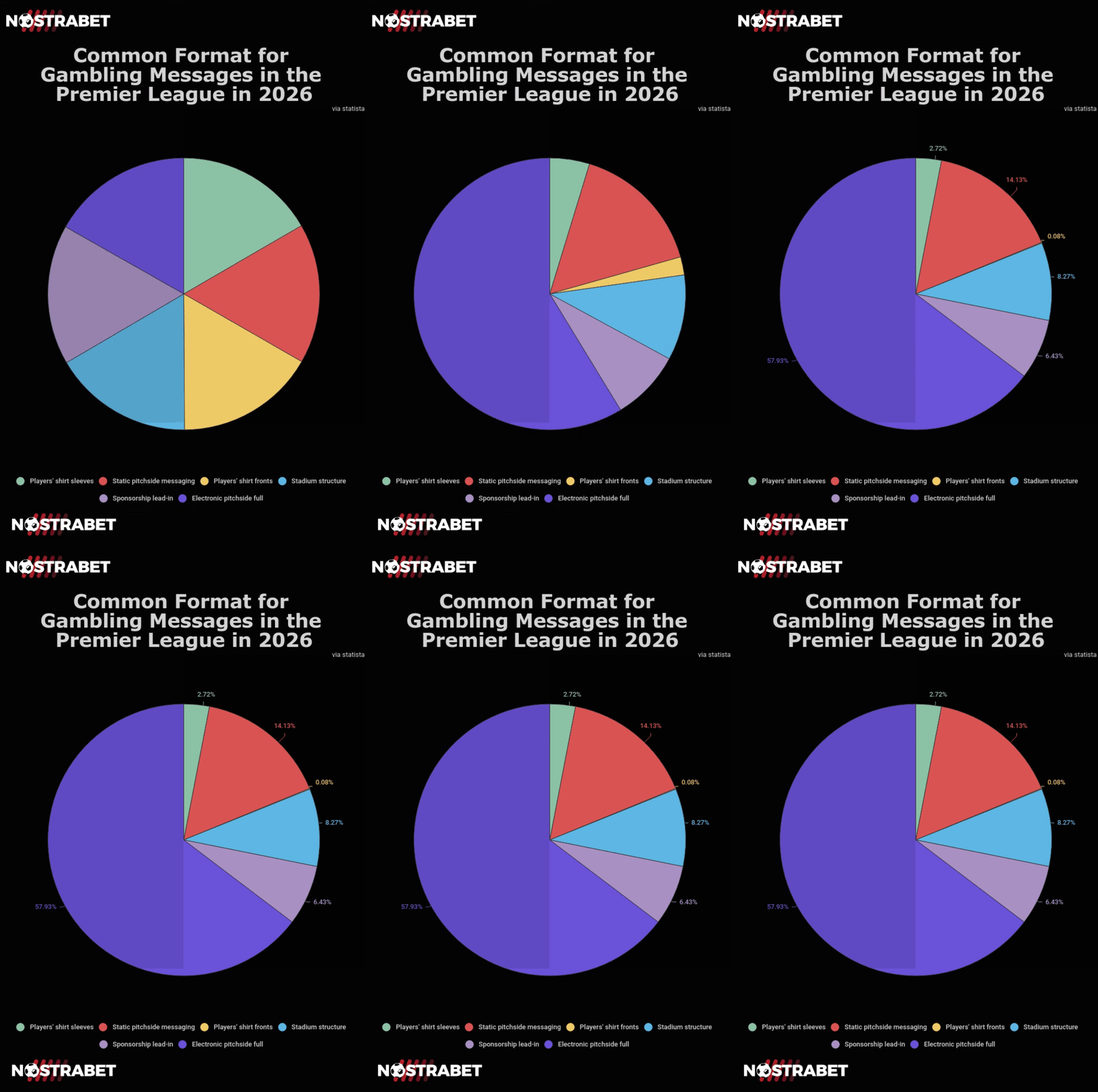
We found an interesting study regarding the location of gambling advertising. In 2026, electronic pitchside accounts for around 57.93% of messages, making it the leading choice for advertisers. When you also add the static pitchside boards (14.13%), the combined pitchside reaches 72.06%.
It’s probably no surprise that electronic displays are very popular among advertisers. Because of how they work, they offer a particularly valuable position because the cameras repeatedly capture them while showing the game. This happens during open play, attacks, corners and replays.
Unlike a commercial break, a logo that you will find on the pitchside will appear alongside the action. This allows the brand in question to gain more exposure without requiring the audience to stop following the game.
Outside of that, you can also find ads on stadium structures (8.27% are there) and sponsorship lead-ins (6.43%). Interestingly, players’ shirt sleeves contribute around 2.72%. Shirt fronts account for just 0.08%, which is not surprising, considering the recent legislative changes. Speaking of the devil, let’s learn more about that.
Shirt-Front Restrictions Have Changed the Advertising Mix
As mentioned earlier, the Premier League underwent major changes recently. The league actually got a ban on gambling sponsors appearing on the front of the matchday shirts. The new ban came into effect for the 2026/27 season, but clubs agreed to these changes back in 2023.
Needless to say, not all football clubs supported this decision. The change actually removed one of the sport’s most recognisable gambling advertising positions. According ot the University of Bristol, the ban reduced the live-match gambling messages by 10.5%.
What’s interesting is that the sleeve exposure increased from 0.80% to 2.72% in 2026. This may not come as a surprise because once something popular is gone, people start paying more attention to other options.
So, What Supporters Actually See During a Broadcast?
Based on research after seven games that were broadcast on TV, there were 11,205 gambling messages. A deeper dive into the stats shows that people could see at least one gambling-related message for around 5 h 16 min. The average was 6.95 messages per broadcast minute.
In the game between Newcastle United and Liverpool, for example, there were 2702 recorded messages. This means there are around 12.17 messages per minute, and gambling branding appeared in around 40.71% of those messages.
Aside from the gambling ads during the live match, the research shows other interesting stats. There were a total of 15,571 gambling messages across live matches, sports news, radio and selected social media.
The exposure itself extends beyond television, as there were 1023 paid gambling ads on Facebook and Instagram. Some stats show that these sounds will reach around 153M accounts in total. This is a very high number and shows the importance of all marketing channels.
The Difference Between Advertising Exposure and Actual Engagement
It’s important to know that advertising exposure doesn’t always translate into engagement. In other words, even if a given gambling brand appears on the screen, it doesn’t mean that viewers will remember it or visit the site to place bets.
With that said, repeated exposure can still play an important role. Although fans mostly focus on what happens on the pitch, seeing the same brands over and over usually makes these companies more popular. This is the big reason why they continue to invest tons of cash in football sponsorships.
It’s also interesting how the different audiences react to these messages. Some of the regular football fans may not be interested in using the bookies in question, but occasional bettors are different. They may be more influenced to check them following the repeated advertising.
UK Online Sports Betting Could Approach $5 Billion
While it is true that some recent restrictions have negatively impacted the UK’s iGaming industry, the long-term statistics paint a different picture. According to research from Statista, the UK online sports betting market could reach almost $5B in 2030. The number was $2.43B in 2017 and reached $3.80B in 2026. In other words, the market would grow by around 28.9% between 2026 and 2030, which is very impressive.
Of course, the figures after 2026 are just estimates, so they may differ. It will really depend on whether we will see additional restrictive legislative changes. The UKGC may decide to restrict all forms of gambling ads in the future, and this could reduce the overall growth of the industry.
Bear in mind that the market has not grown in a straight line. Statista’s figures show that it reached $2.91B in 2018, but then it fell to $2.51B in 2019. If there are major legislative changes limiting gambling ads, the overall market could see a small decline over the next two years.
Football Remains the Most Attractive Option for Betting Brands
The UK’s sports betting industry includes more than just football. Nevertheless, this sport and the English Premier League in particular remain the centre of attention. The competition provides operators with regular fixtures, large audiences and intense supporter engagement.
When it comes to marketing, the popularity of the league makes broadcast and stadium visibility valuable. Brands pay large amounts of money to have their names beside the pitch. This allows them to stay familiar to viewers without interrupting the match.
Unsurprisingly, football clubs also take full advantage of the league’s popularity. They sign these huge sponsorship deals that give them millions every year.
Who will Replace Gambling Sponsors in the Premier League?
If regulations in the UK continue to tighten, we may see further restrictions that could impact the entire EPL advertising business. All big betting operators have been key commercial partners for years. Their removal from shirt fronts, however, created opportunities for businesses from other industries.
We can expect to see tech companies, financial services, travel brands and even big international companies. With that said, replacing gambling sponsors won’t be as easy as it sounds. This is especially true for some smaller clubs, as it will be hard for them to attract major international brands.
We would not be surprised if many gambling companies decide to redirect their marketing budget. They may focus on advertising boards, digital partnerships and other sponsorship positions.
So, Are Gambling Restrictions Achieving Their Purpose?
The answer to this question is not as straightforward as it seems. Research at Briston shows that around 93% of the gambling-content posts did not really qualify as advertising.
Assuming that the problem of gambling-related cases continues to increase, the government may impose further restrictions. We may even see a full ban on gambling advertising, similar to what authorities in Bulgaria are trying to achieve. We will have to wait and see what happens in the next couple of years.
We don’t expect to see more drastic changes in the local iGaming industry, such as the one in Brazil. As you probably know, the latter imposed a complete sports betting ban, and it has serious consequences for the local economy.
No comments added yet. Be the first!